Overview
This work develops a quantitative group-theory framework for finding the approximate, or hidden, symmetry of tetragonal methylammonium lead iodide. It connects atomic structure, vibrational modes, and response tensors to identify which symmetry descriptions remain physically meaningful in this dynamically disordered material.
Key resultQuasi-I4cm retains several expected tetragonal subgroups, whereas quasi-I4/mcm is described more accurately by the lower C2v symmetry.
My contributionMethod development, group-theory analysis, vibrational-mode classification, and response-tensor calculations.
Research question
How can symmetry remain scientifically useful when a material has no exact symmetry in its static atomic coordinates?
Approach
- Mode-by-mode decomposition into irreducible representations
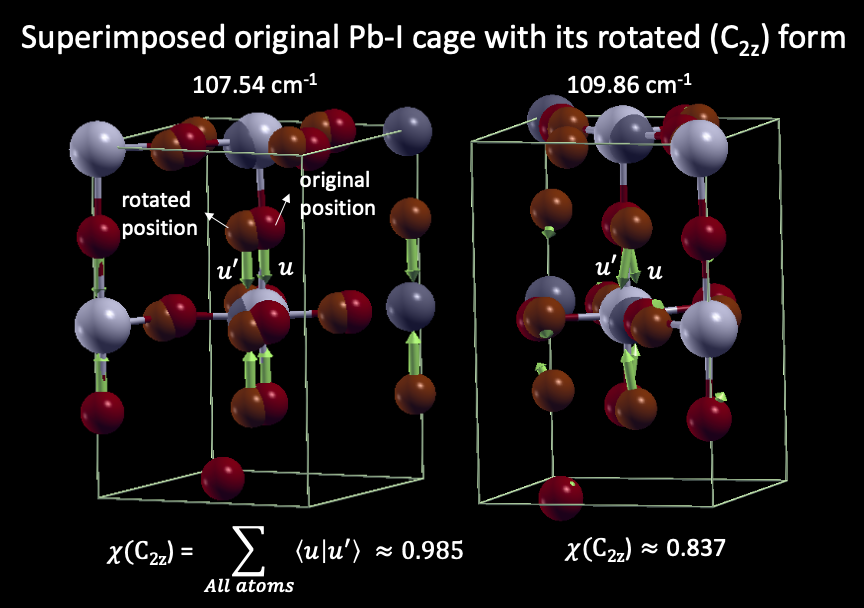
- Quantitative comparison of vibrational modes under symmetry operations
- Rotation analysis of dielectric, elastic, electro-optic, Raman, Born-charge, and dynamical-matrix tensors
- Validation with symmetric reference materials and implementation through Quantum ESPRESSO
What emerged
- The quasi-I4cm structure is best described by the lower-symmetry point groups D2d, C4v, and D4.
- The nominally quasi-I4/mcm structure is better represented by C2v than by the expected D4h symmetry.
- Different modes and response tensors retain different degrees of approximate symmetry, creating a practical combined picture for spectroscopy.
- The method generalizes to doped, polycrystalline, amorphous, and other approximately symmetric materials.
Explain the work
Media and supporting material
This area is ready for a short video, selected presentation slides, figures, datasets, or an interactive explanation as the project page develops.
Project media
Video · slides · figures